Case study · BulutFeatured
Routing
AI-assisted route planning for logistics
- Role
- Product Designer, one of two designers on the project, working with the AI and development teams. I designed the map and timeline; the other designer did the internal forms.
- Context
- Bulut
- Tools
- LogisticsAIEnterprise
The result, first
What changed because of this work
< 30 min
Planning time, down from 4 to 5 hours
600+
Delivery units clustered by AI
20K
Units the system can handle
Route planning time
-89%01
Context
The problem
The routing module speeds up warehouse picking and loading by replacing manual route decisions with AI-assisted planning. It clusters deliveries, suggests optimal paths and still allows manual customization.
What was broken
Everything started on paper: invoices were printed and sorted by hand. Planners then keyed each route one by one into a table inside a Windows sales program. Route planners assembled delivery paths by hand from paper invoices. Manual routing took 4 to 5 hours per day, produced frequent errors and could not scale to volumes that could exceed 20K units. The process also depended on one person's experience, which created operational risk.
02
Approach
How I got there
01
Business meetings, desk research on best practices and alignment on the solution, alongside the field work below.
02
On-site field research at the Tabriz and Karaj distribution offices, watching route planners lay out paper invoices one by one. The work depended on one person: the company's longest-serving driver, who had become transport manager. When he was away, planning took much longer.
03
In-person interviews with branch managers, transportation supervisors and route planners.
04
Competitor analysis of Routific, OptimoRoute and Optime AI, plus a local fleet and logistics product.
05
Several alignment sessions with the AI and development teams to define the product direction.
Discovery
Research
03
Limits
Constraints I worked within
- Technical: the team faced hard algorithmic challenges. Google's map and traffic data is not available in Iran, which made it harder for the engineering team to give a correct route.
- Business: there were no commercial constraints that shaped the design.
04
Thinking
Key decisions
The calls that shaped the product, and the reason behind each one.
A learning model improves with every change planners make: each correction becomes new data, so over time the model gives better routes.
If the model fails or a planner disagrees with it, they can still build the route by hand, so the work never stops.
The model plans behind the scenes. The planner does not operate it, only reviews the result, so the interface stays simple.
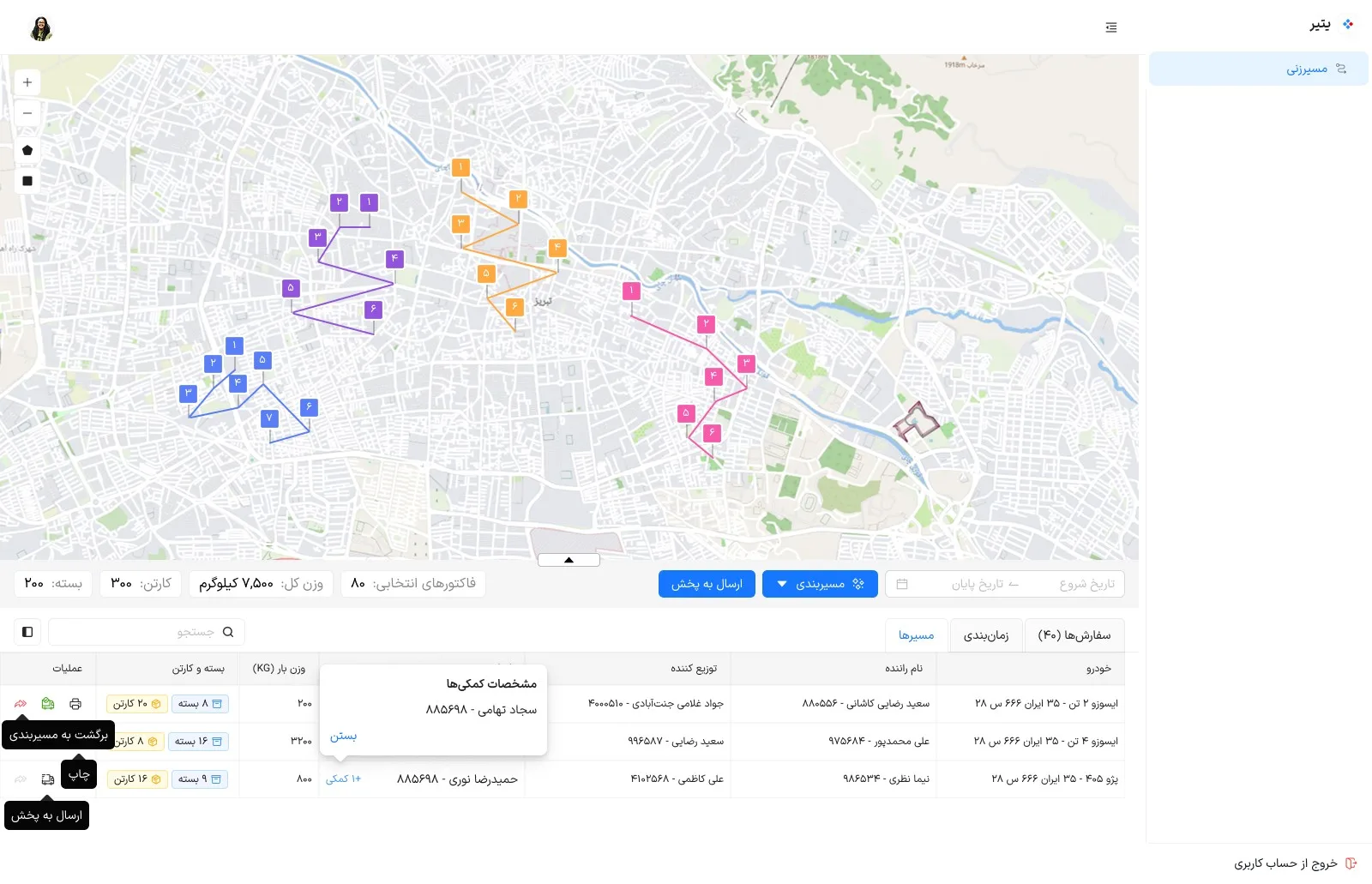
Each truck's route has its own colour with numbered stops on the map, and the same colour on its timeline row below. The planner sees which stops belong to which truck, and a summary bar shows the selected invoices, total weight and truck count.
Planners can drop a stop on the map route and move it from one cluster to another, so correcting the AI's plan takes a drag instead of a re-plan.
05
Solution
What I designed
- Manual route planning: a digital interface for building routes without paper.
- AI-assisted smart routing: trained on historical routing data, it clusters 600+ delivery units and suggests the best path. The algorithm proposes the priorities and the planner corrects them, instead of keying every stop by hand.
- End-to-end flow after launch: the deployment team installed it, and planners run it themselves. The algorithm produces the routes, the planner edits them when needed and assigns the driver to each vehicle, and the loading order of each vehicle is sent to the warehouse.
The craft
Screens
Why so few screens? Most of this work is under NDA, so I can only share a small part of it. I am happy to walk through the rest in a conversation.
06
Impact
Results
- Manual planning time fell from 4 to 5 hours per day to under 30 minutes. I measured this myself by going back on site after launch and watching the planners close routes in about half an hour, with far less effort.
- The model keeps improving: the planners' manual edits are fed back as new data, so each round of learning makes its suggestions better.
- Dependence on a single route planner was eliminated.
- Route accuracy and consistency improved through AI-driven pattern recognition.
- The workflow became faster, more predictable and scalable, reducing operational overhead.