Case study · Shoniz
Ding
A modern, stable and scalable internal communication platform
- Role
- Junior UI/UX Designer
- Context
- Shoniz
- Tools
- CommunicationMobileEarly work
01
Context
The problem
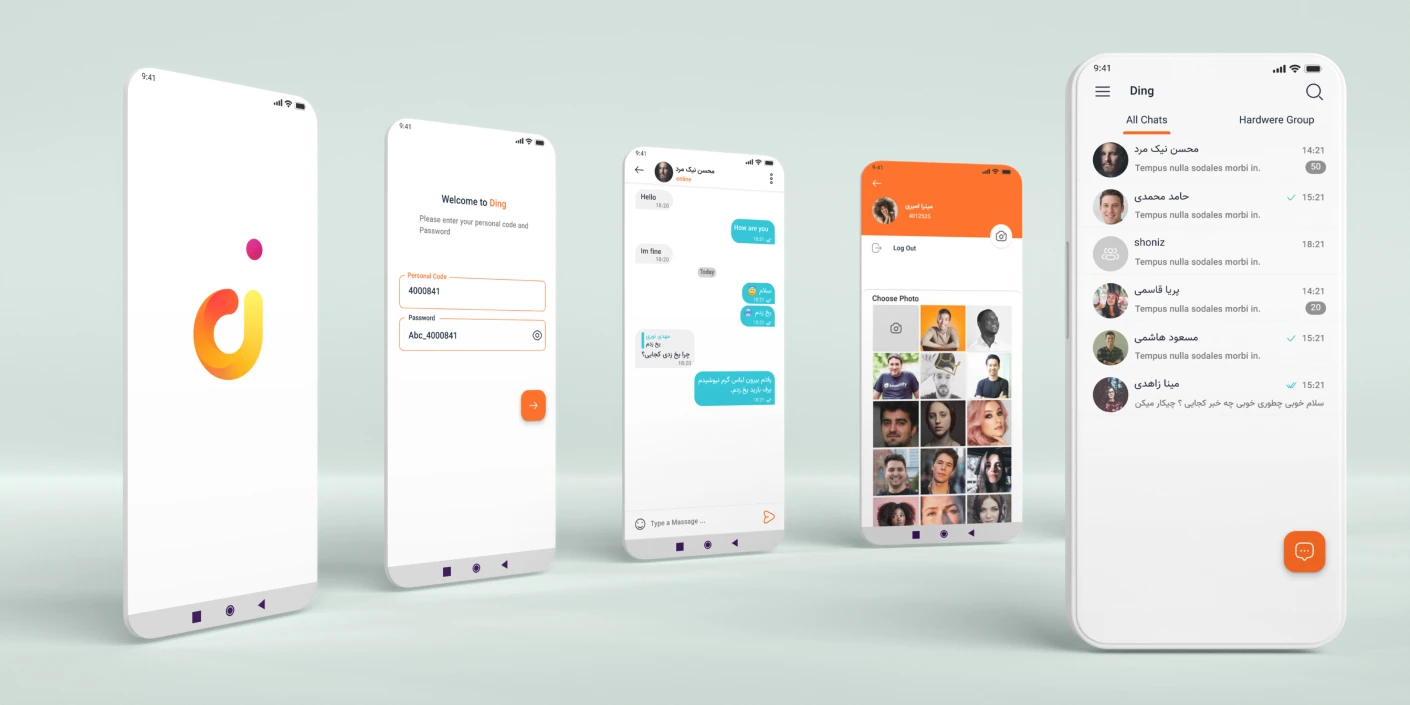
Ding was planned as an internal company tool to replace an existing communication app. It brings internal communication into one platform that people can use on a phone and on desktop to message, share files and talk by voice. It was published on the Bazaar marketplace, and it was shut down after the lead developer left.
What was broken
Internal communication was scattered across multiple disconnected tools, which made conversations hard to follow, files easy to lose and collaboration slower than it needed to be.
02
Approach
How I got there
01
Spoke with the product owner and the people who would use it to understand the real work, and looked at similar products to learn what already works. I was a junior designer, so I took their feedback in every review round.
02
Competitive analysis across Microsoft Teams, Slack, Pumble, Ryver, Google Chat, Zoho Cliq, Twist, Teamwork Chat and Flock, plus relevant apps on Bazaar and Google Play.
03
Mapped the UX patterns, trust signals and messaging flows modern users expect, and decided what fits the teams best.
04
Drew the core flows and the screens, keeping them as simple and clear as I could.
03
Thinking
Key decisions
The calls that shaped the product, and the reason behind each one.
Communication was scattered across disconnected tools, so conversations were hard to follow and files easy to lose.
04
Solution
What I designed
- Direct chat for fast one-to-one conversations.
- Channels to organize team and topic-based discussions.
- File sharing so resources stay attached to the right conversations.
- Voice calls for real-time communication without leaving the app.
The craft
Screens
Why so few screens? Most of this work is under NDA, so I can only share a small part of it. I am happy to walk through the rest in a conversation.
05
Impact
Results
- A single, unified space where conversations, files and calls live together.
- Reduced friction, kept teams aligned and made everyday collaboration noticeably simpler.
- The product was already giving results, but the architecture was hard, and when the lead developer left the company the project failed. Impact was not measured in numbers, so these results are qualitative.